
In today’s competitive startup ecosystem, having a strong idea is not enough. If your startup does not have a clear, fast, and trustworthy online presence, scaling becomes extremely difficult. That is why founders actively search for website development services for startups—not just to build a website, but to create a growth-focused digital foundation.
A startup website is often the first touchpoint for investors, customers, partners, and even future employees. A poorly built website can kill trust instantly, while a well-structured and conversion-optimized site can help you attract funding, acquire users, and validate your product-market fit.
This blog explains everything startups need to know about website development in 2026—from features and cost to process, SEO, and growth strategy.
Why Is a Website So Important for Startups?

For startups, a website is more than a digital visiting card. It plays a critical role at every stage of growth.
Investors often check your website before a pitch meeting. Customers evaluate your credibility based on design, speed, and clarity. Early adopters decide whether to sign up or bounce within a few seconds. This makes professional website development services for startups a strategic investment rather than an expense.
A strong startup website clearly communicates:
-
What problem you solve
-
Who your product is for
-
Why your solution is better
-
What action users should take next
When these elements are aligned, your website becomes a powerful growth engine.
What Do Website Development Services for Startups Include?
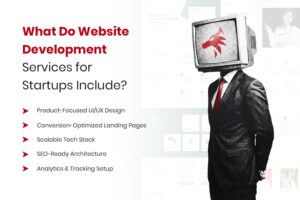
When an agency specifically offers website development services for startups, their approach is different from regular business websites. The focus is on speed, scalability, experimentation, and growth.
Product-Focused UI/UX Design
Startup websites prioritize clarity over decoration. Design focuses on landing pages, feature sections, pricing pages, and storytelling that supports conversions.
Conversion-Optimized Landing Pages
Lead forms, demo booking, waitlists, beta signups, and CTA placement are carefully planned to support growth goals.
Scalable Tech Stack
Modern frameworks and CMS setups are used so the website can evolve alongside your product without frequent rebuilds.
SEO-Ready Architecture
Clean URLs, fast loading speed, mobile-first layout, and proper heading structure are built from day one.
Analytics & Tracking Setup
Tools like GA4, event tracking, funnels, and heatmaps are integrated so founders can measure what works and what doesn’t.
To understand how professional web solutions are structured, you can explore:
https://webwolfz.com/web-development-service/
Ready-Made Template vs Custom Website for Startups
One of the most common dilemmas founders face is whether to use a template or invest in a custom-built website.
| Factor | Template-Based Website | Custom Startup Website |
|---|---|---|
| Launch Speed | Very fast (few days) | Takes more time |
| Branding | Generic, looks similar | Unique brand identity |
| Conversion Control | Limited flexibility | Fully customizable |
| Scalability | Hard to extend later | Easy to scale |
| Cost | Low initial cost | Higher initial, better ROI |
Templates may work for very early MVPs, but as soon as traction grows, startups usually need custom website development services for startups to support experimentation and long-term growth.
Startup Website Development Process (Step-by-Step)
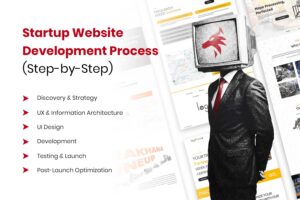
A startup-focused web development partner follows a clear and outcome-driven process.
1. Discovery & Strategy
The team understands your business model, ICP (ideal customer profile), competitors, and growth objectives. At this stage, the primary website goal is defined—leads, signups, demos, or downloads.
2. UX & Information Architecture
Pages like Home, Product, Pricing, About, Blog, and Contact are structured. User journeys are mapped from awareness to conversion.
3. UI Design
Clean, modern, and investor-friendly designs are created. Mobile-first approach is prioritized as most startup traffic comes from smartphones.
4. Development
Front-end is optimized for speed and SEO, while the backend or CMS is kept simple enough for non-technical founders to manage.
5. Testing & Launch
Cross-browser testing, speed checks, and CTA validation are done before launch. Analytics events are configured for growth tracking.
6. Post-Launch Optimization
Based on data, new sections, FAQs, case studies, or landing pages are added to improve conversions.
Website Development Cost for Startups (India-Focused)

Startup founders often want clarity on budget before committing.
MVP / Early-Stage Startup Website
Simple landing page, basic content pages, and form integration.
Cost usually falls in the lower range, with a timeline of 1–3 weeks.
Funded / Growth-Stage Startup Website
Multiple layouts, custom components, animations, blog, and integrations.
Mid-range investment with a 4–8 week timeline.
Complex SaaS or Product-Led Website
Documentation, hybrid marketing + product pages, and scalable architecture.
Higher investment depending on complexity.
In the Indian market, startups typically invest anywhere between ₹40,000 to ₹3,00,000+, depending on scope and goals.
👉 Need a Startup-Focused Website?
If you are looking for website development services for startups that focus on conversions, scalability, and SEO from day one, now is the right time to take action.
👉 Talk to our team here:
https://webwolfz.com/contact-us/

How to Choose the Right Web Development Partner for a Startup
When founders search for website development services for startups, they usually evaluate agencies on these parameters:
-
Proven startup or SaaS experience
-
Strong portfolio and real case studies
-
Use of modern, scalable tech stack
-
SEO and performance-first approach
-
Clear communication, timelines, and pricing
At WebWolfz, we work closely with startups to build fast, growth-ready websites that support fundraising, lead generation, and user acquisition.
Essential Features Every Startup Website Must Have
Founders often look for a practical checklist. These features are critical:
-
Clear value proposition above the fold
-
Strong CTAs like “Book a Demo” or “Join Waitlist”
-
Social proof (logos, testimonials, press mentions)
-
Product or solution explanation with visuals
-
Blog or resources section for SEO and authority
-
Contact forms, chat widgets, or scheduling tools
SEO & Growth Strategy for Startup Websites

Building a website is only half the job. Growth comes from visibility and experimentation.
Keyword Strategy
Target long-tail keywords like website development services for startups, startup website development company, and affordable website for startups.
On-Page SEO
Use the main keyword in H1, URL, first 100 words, and 1–2 subheadings naturally. Optimize meta tags, images, and internal links.
Content Marketing
Publish blogs, founder stories, comparisons, and use-case guides to build authority over time.
Modern SEO and performance practices often follow global web standards that define accessibility, speed, and compatibility, helping ensure websites remain future-ready and user-friendly across devices and browsers (https://www.w3.org/).
FAQs – Website Development for Startups
What is included in website development services for startups?
They include strategy, UI/UX design, development, SEO-ready structure, analytics, and post-launch optimization.
Should early-stage startups focus on design or speed first?
Speed and clarity should come first, followed by visual enhancements.
What is the average startup website development cost in India?
It usually ranges from ₹40,000 to ₹3,00,000+, depending on complexity.
Is a template website good for startups?
Templates can work initially, but custom websites perform better for scaling and growth.
How can a startup website rank on Google?
By targeting the right keywords, optimizing on-page SEO, and publishing consistent, helpful content.