

Getting visitors to your website is only half the battle. The real challenge is turning those visitors into leads, customers, subscribers, or paying clients.
Many businesses spend thousands of dollars on SEO, PPC advertising, and social media marketing, only to discover that their website fails to convert visitors effectively. The reason is often not traffic quality but poor user experience.
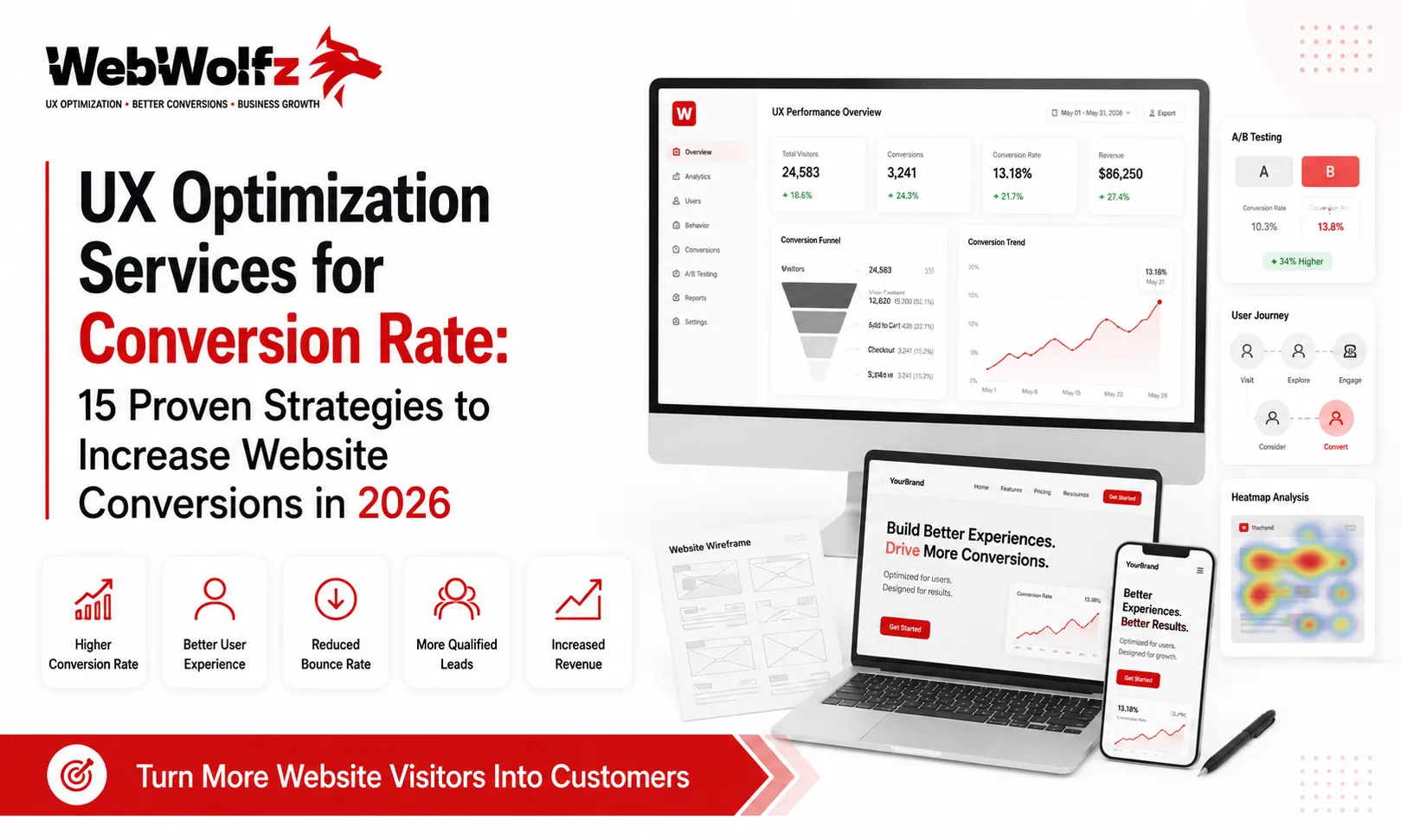
This is where UX optimization services for conversion rate become essential. A well-optimized user experience can dramatically improve conversions, reduce bounce rates, and increase revenue without spending more on traffic acquisition.
In this guide, you’ll learn 15 proven UX optimization strategies that help businesses improve conversion rates in 2026.
What Is UX Optimization?
UX optimization is the process of improving a website’s usability, navigation, design, and user journey to help visitors complete desired actions.
These actions may include:
- Submitting a contact form
- Making a purchase
- Booking a consultation
- Downloading a resource
- Requesting a quote
- Signing up for a newsletter
Unlike traditional conversion rate optimization that often focuses only on testing buttons and headlines, UX optimization focuses on improving the entire customer journey.
According to usability research published by Nielsen Norman Group, better user experiences directly influence customer satisfaction, engagement, and task completion rates.
Why UX Matters for Conversions
Visitors make decisions quickly.
If they experience confusion, frustration, or uncertainty, they leave.
Common UX issues include:
- Slow loading pages
- Complicated navigation
- Poor mobile experience
- Weak calls-to-action
- Cluttered layouts
Improving these areas often leads to significant conversion improvements.
Businesses looking for professional support can explore:
https://webwolfz.com/ui-ux-design/
1. Simplify Website Navigation
Users should find information within seconds.
Effective navigation should:
- Be consistent
- Use clear labels
- Minimize unnecessary options
- Highlight key pages
Poor navigation increases abandonment rates.
Related guide:
https://webwolfz.com/blog/user-interface-design-services-for-websites/
2. Improve Mobile User Experience
Mobile traffic continues to dominate across most industries.
A poor mobile experience can significantly reduce conversions.
Focus on:
- Responsive layouts
- Larger tap targets
- Faster mobile performance
- Mobile-friendly forms
Helpful resources:
https://webwolfz.com/blog/mobile-friendly-website-design-company-india/
https://webwolfz.com/blog/responsive-website-design-services-india/
3. Reduce Page Load Times
Speed directly affects conversions.
According to performance recommendations from Google PageSpeed Insights, faster websites generally provide better user experiences and engagement.
Ways to improve speed:
- Compress images
- Use caching
- Minimize scripts
- Optimize hosting
4. Strengthen Your Call-to-Actions
Visitors should always know the next step.
Effective CTAs are:
- Visible
- Action-oriented
- Specific
- Easy to find
Examples include:
- Request a Quote
- Schedule a Consultation
- Start Free Trial
5. Create Clear Visual Hierarchy
Users scan websites rather than reading every word.
Visual hierarchy helps guide attention toward:
- Headlines
- Benefits
- Testimonials
- CTAs
Good hierarchy improves decision-making.
6. Simplify Contact Forms
Long forms often reduce conversion rates.
Ask only for essential information.
For most businesses, these fields are enough:
- Name
- Phone
- Message
Reducing friction increases submissions.
7. Use Social Proof Strategically
Trust influences conversions.
Effective social proof includes:
- Reviews
- Testimonials
- Case studies
- Client logos
Visitors are more likely to take action when they see evidence of success.
8. Conduct UX Research
Assumptions often lead to poor decisions.
UX research reveals:
- User goals
- Pain points
- Frustrations
- Navigation behavior
Learn more:
https://webwolfz.com/blog/ux-research-services-for-startups/
9. Perform Regular Usability Testing
Even experienced designers cannot predict every user behavior.
Testing helps uncover:
- Confusing layouts
- Navigation issues
- Form problems
- Conversion barriers
Related resource:
https://webwolfz.com/blog/usability-testing-services-for-websites/
10. Optimize Landing Pages
Landing pages should focus on one primary goal.
Best practices include:
- Clear headline
- Strong benefits
- Trust indicators
- Single CTA
Helpful guide:
https://webwolfz.com/blog/ui-ux-design-services-for-startups/
11. Improve Website Readability
Content should be easy to scan.
Use:
- Short paragraphs
- Bullet points
- Subheadings
- White space
Readability directly impacts engagement.
12. Use Wireframes Before Redesigning
Many redesigns fail because they skip planning.
Wireframing helps:
- Test ideas
- Validate layouts
- Improve user flows
Related guide:
https://webwolfz.com/blog/wireframing-and-prototyping-services/
13. Conduct Regular UX Audits
A UX audit identifies conversion obstacles before they impact revenue.
Audits typically evaluate:
- Navigation
- Design consistency
- Mobile usability
- User journeys
Helpful resource:
https://webwolfz.com/blog/ui-ux-audit-services-for-websites/
14. Eliminate Common Website Design Mistakes
Many businesses unknowingly create friction through poor design decisions.
Common problems include:
- Too many popups
- Hidden contact information
- Weak CTA placement
- Cluttered layouts
Learn more:
https://webwolfz.com/blog/common-website-design-mistakes-to-avoid/
15. Focus on Continuous Improvement
Optimization is not a one-time project.
Successful businesses continuously:
- Test improvements
- Analyze user behavior
- Monitor conversion metrics
- Refine experiences
This approach delivers long-term growth.
UX Optimization for Different Website Types
Business Websites
Focus on trust and lead generation.
Ecommerce Stores
Prioritize product discovery and checkout optimization.
Helpful resource:
https://webwolfz.com/blog/ui-ux-design-for-ecommerce-websites/
SaaS Products
Focus on onboarding, retention, and feature adoption.
Related guides:
https://webwolfz.com/blog/ui-ux-design-services-for-saas-startups/
https://webwolfz.com/blog/ui-ux-design-agency-for-saas-products/
Mobile Applications
Require touch-friendly experiences and simplified navigation.
Helpful guide:
https://webwolfz.com/blog/mobile-app-ux-design-services-india/
How UX Optimization Impacts Revenue
Better user experiences influence:
- Conversion rates
- Customer retention
- Lead quality
- Average order value
- Customer satisfaction
According to user experience research published by Interaction Design Foundation, improving usability often increases engagement and task completion rates.
This is why many organizations invest in UX optimization services for conversion rate rather than spending exclusively on advertising.
Why Many Businesses Choose WebWolfz
Improving conversion rates requires more than attractive design.
It requires:
- UX research
- Interface design
- Testing
- Analytics
- Optimization
WebWolfz helps businesses create user-focused experiences designed to improve engagement and conversions.
Instead of spending months diagnosing usability problems internally, many businesses choose to work with specialists who understand both user behavior and business growth.
Explore UX services:
https://webwolfz.com/ui-ux-design/
Or discuss your project:
https://webwolfz.com/contact-us
Final Thoughts
Increasing website conversions does not always require more traffic.
Often, the fastest growth comes from improving the experience users have after they arrive.
Professional UX optimization services for conversion rate help businesses reduce friction, improve usability, and guide visitors toward meaningful actions.
Whether you operate a business website, ecommerce store, SaaS platform, or mobile application, investing in user experience can generate measurable improvements in conversions and long-term revenue.
Businesses that prioritize UX in 2026 will have a significant competitive advantage over those that focus solely on traffic generation.
Frequently Asked Questions
What are UX optimization services for conversion rate?
These services improve website usability, navigation, design, and user journeys to help increase conversions and reduce bounce rates.
How does UX affect conversion rates?
A better user experience reduces friction, improves trust, and makes it easier for visitors to complete desired actions.
What is the difference between UX and CRO?
UX focuses on improving the overall user experience, while CRO focuses specifically on increasing conversion rates. Both work together to improve performance.
How often should a website undergo UX optimization?
Most businesses should review and optimize UX regularly, especially after major updates, redesigns, or traffic growth.
Why choose WebWolfz for UX optimization?
WebWolfz provides UX research, audits, usability testing, interface improvements, and conversion-focused design strategies tailored to business goals.