

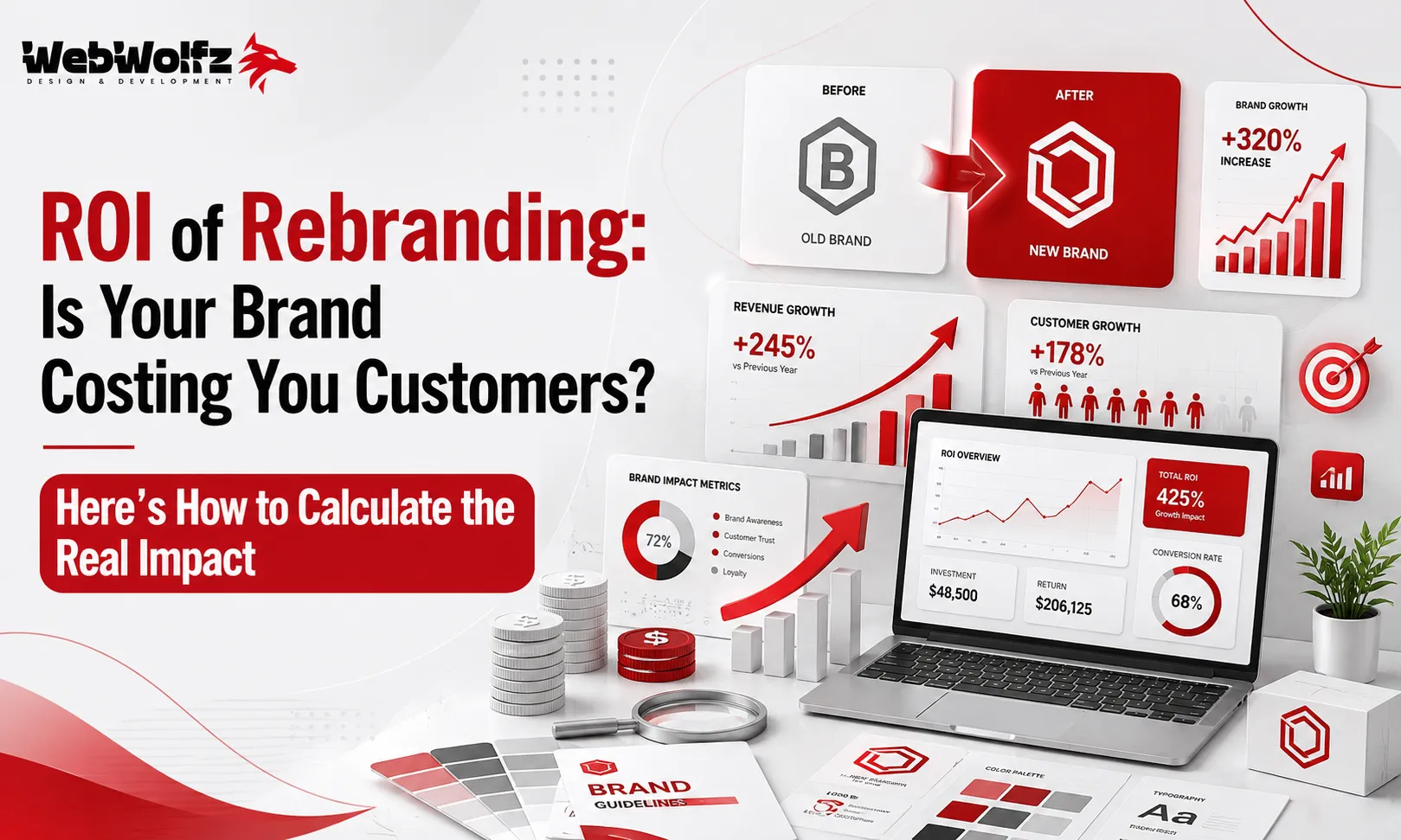
When businesses think about rebranding, the first thing that usually comes to mind is a new logo, fresh colors, or an updated website. While these visual changes are important, they represent only a small part of what rebranding truly means.
A successful rebrand changes how people perceive your business. It strengthens trust, improves recognition, increases conversions, and helps customers choose you over competitors. The real question isn’t, “How much will rebranding cost?” It’s, “How much is my current brand already costing me?”
Many businesses continue losing customers every day because their branding no longer reflects the quality of their products or services. An outdated identity can make even an excellent company appear less trustworthy than competitors with stronger branding.
This is where understanding the ROI of Rebranding becomes essential. Instead of treating branding as an expense, successful companies evaluate it as an investment that generates measurable business returns over time.
In this guide, you’ll learn how to calculate the true impact of rebranding, identify the hidden costs of an outdated brand, and determine whether now is the right time to invest in a stronger business identity.
Why Rebranding Is About More Than a New Logo
One of the biggest misconceptions in business is believing that rebranding simply means replacing an old logo.
In reality, modern rebranding touches almost every customer interaction, including:
- Brand identity
- Logo design
- Website experience
- Brand messaging
- Typography
- Color system
- Marketing materials
- Social media presence
- Customer perception
Every one of these elements influences how customers evaluate your business before they decide to contact you.
Research from the Harvard Business Review highlights that strong brands create competitive advantages by building trust and influencing purchasing decisions over time rather than relying solely on price.
When customers immediately recognize professionalism and consistency, they’re far more likely to engage with your business.
The Hidden Cost of an Outdated Brand
Many business owners never realize how much money they’re losing because poor branding rarely appears on a financial statement.
Instead, the losses show up indirectly.
For example:
A visitor lands on your website.
They compare your business with two competitors.
All three companies offer similar services.
However, one competitor has:
- Modern branding
- Professional website
- Consistent visuals
- Clear messaging
- Strong credibility
Without realizing it, the customer begins associating that business with higher quality.
The result?
They leave your website without making an enquiry.
Nothing appears in your analytics saying, “Your brand caused this customer to leave.”
Yet that’s exactly what happened.
Multiply that situation by hundreds or thousands of visitors each month, and the financial impact becomes significant.
Common Signs Your Brand Is Losing Customers
Businesses often ignore early warning signs because they happen gradually.
Ask yourself these questions:
- Does your logo look outdated compared to competitors?
- Has your website remained unchanged for several years?
- Are customers asking whether you’re still in business?
- Is your visual identity inconsistent across platforms?
- Do marketing materials feel disconnected?
- Has lead generation slowed despite increasing marketing spend?
- Are competitors charging higher prices while attracting more customers?
If you answered yes to several of these questions, your branding may already be reducing customer confidence.
Many businesses initially improve individual assets such as their website before investing in a complete brand refresh. If you’re evaluating your online presence, our guide on Website Redesign Services for Existing Businesses explains how modern websites contribute to stronger brand perception.
Why Customer Perception Matters More Than Ever
Today’s customers make decisions quickly.
Before speaking to your sales team, they often evaluate your business based on:
- Google search results
- Website quality
- Brand consistency
- Online reviews
- Social media presence
- Visual identity
Within seconds, they begin forming opinions about credibility.
According to Nielsen, brand trust remains one of the strongest factors influencing purchasing decisions across industries.
This is why businesses with similar products often experience dramatically different conversion rates.
Customers don’t only buy products.
They buy confidence.
What Does Return on Investment Actually Mean?
Every business investment should produce measurable value.
The same principle applies to branding.
Rather than asking whether a rebrand looks attractive, business owners should ask questions such as:
- Did enquiries increase?
- Did conversion rates improve?
- Did customer acquisition costs decrease?
- Did website engagement improve?
- Did repeat purchases increase?
- Did average order value grow?
- Did customer trust improve?
These metrics provide a much clearer picture of business performance than visual preferences alone.
The Business Metrics That Matter
Rebranding can influence several measurable performance indicators.
Some of the most valuable include:
Revenue Growth
An improved brand often attracts higher-quality leads and supports premium pricing.
Conversion Rate
Professional branding reduces hesitation and increases customer confidence.
Customer Retention
Customers are more likely to remain loyal to brands they trust.
Lead Quality
Better positioning often attracts customers who are a stronger fit for your services.
Average Project Value
Premium branding can justify higher pricing because customers perceive greater value.
Together, these metrics help businesses understand whether branding investments are delivering long-term returns.
Start Measuring Before You Rebrand
One of the biggest mistakes companies make is launching a new brand without recording their current performance.
Before making any changes, collect baseline data such as:
- Monthly website traffic
- Lead enquiries
- Conversion rate
- Bounce rate
- Customer retention
- Average sale value
- Revenue per customer
- Social engagement
- Branded search volume
These numbers become your benchmark for measuring future improvement.
If your website also needs modernization, combining branding with improved user experience often produces stronger business results. Our article on Why UI UX Design Is Important for Websites explains how design directly affects customer confidence and conversions.
Likewise, businesses planning a broader digital transformation should also review our guide on Brand Strategy and Design Services in India, which explains how branding decisions support long-term business growth.
How to Calculate the ROI of a Rebrand
Many business owners assume branding is difficult to measure because it involves perception, trust, and design. While those factors are important, the financial impact can be calculated using measurable business data.
The standard ROI formula is:
ROI (%) = ((Gain from Investment − Cost of Investment) ÷ Cost of Investment) × 100
For example, imagine a company spends $12,000 on a complete rebrand that includes a new visual identity, website redesign, marketing collateral, and updated messaging.
Over the following 12 months:
- Additional revenue generated: $60,000
- Cost of rebranding: $12,000
ROI = (($60,000 − $12,000) ÷ $12,000) × 100
ROI = 400%
This calculation shows that rebranding should be viewed as a long-term business investment rather than a one-time design expense.
Metrics That Reveal the Real Business Impact
A successful rebrand doesn’t improve only one metric. Instead, it creates positive movement across several business areas.
1. Conversion Rate
If more visitors become paying customers after your rebrand, your branding is helping remove hesitation and build trust.
For example:
Before rebrand:
- Website visitors: 5,000
- Leads: 100
- Conversion Rate: 2%
After rebrand:
- Website visitors: 5,000
- Leads: 170
- Conversion Rate: 3.4%
Without increasing traffic, the business generates significantly more opportunities.
2. Customer Acquisition Cost (CAC)
A stronger brand often reduces marketing costs because customers trust the business more quickly.
Formula:
Customer Acquisition Cost = Total Marketing Spend ÷ Number of New Customers
If your advertising budget remains the same while customer acquisition increases, your branding is improving marketing efficiency.
3. Customer Lifetime Value (CLV)
Great branding encourages repeat business.
Formula:
Customer Lifetime Value = Average Purchase × Purchase Frequency × Customer Lifespan
An increase in customer loyalty often produces greater returns than simply attracting new customers.
4. Branded Search Volume
One overlooked indicator is how often people search specifically for your business name.
Tools such as Google Search Console and Google Trends can help monitor changes in branded searches over time.
As brand awareness grows, direct searches often increase as well.
5. Bounce Rate and Engagement
Customers form opinions within seconds.
A professional brand identity combined with an improved website experience often results in:
- Lower bounce rates
- Longer session durations
- More page views
- Higher enquiry submissions
These improvements indicate stronger customer confidence.
Rebranding Should Align With Business Goals
Many businesses redesign their logo without addressing deeper branding issues.
Instead, every branding decision should support objectives such as:
- Entering a new market
- Attracting premium clients
- Increasing average order value
- Improving customer trust
- Supporting international expansion
- Launching new services
When branding aligns with business strategy, the results become much easier to measure.
Businesses planning a complete identity refresh should also evaluate their visual communication. Our guide on Business Logo & Brand Identity Design Services explains how a consistent visual identity strengthens long-term recognition.
Common Mistakes That Reduce Rebranding ROI
Even well-intentioned rebrands can fail if they’re approached as purely creative projects.
Some of the most common mistakes include:
Rebranding Without Research
A successful rebrand begins with understanding your audience, competitors, and market position.
Without research, design decisions become subjective rather than strategic.
Ignoring Customer Expectations
Customers already have perceptions about your business.
A dramatic visual change without a clear reason may create confusion instead of excitement.
Updating the Logo Only
Changing a logo while leaving outdated messaging, inconsistent visuals, and poor website experiences untouched rarely produces meaningful business improvements.
Your brand should feel consistent across every customer touchpoint.
Forgetting the Website
Many companies invest heavily in a new identity but continue using an outdated website.
If visitors arrive at an old, slow, or confusing website, the credibility created by your new branding quickly disappears.
That’s why many businesses combine rebranding with modern web design. Our article on Website Design Trends 2026 explores how current design standards influence customer trust and engagement.
Inconsistent Brand Assets
Customers expect consistency.
Your logo, colors, typography, presentations, brochures, proposals, advertisements, and social media should all communicate the same personality.
If every touchpoint feels different, customers struggle to recognize your business.
For companies reviewing their printed and digital assets, our guide on Marketing Collateral Design Services explains how consistent branding improves customer recognition across every channel.
When Is the Right Time to Rebrand?
Many businesses wait until sales decline significantly before considering a rebrand.
In reality, it’s often smarter to act earlier.
Some indicators include:
- Your competitors look noticeably more modern.
- Your services have expanded beyond your original positioning.
- Your audience has changed.
- Your website no longer reflects your expertise.
- Your visual identity feels outdated.
- Your business is targeting larger clients.
- You’re entering new markets.
- Your marketing campaigns are producing weaker results.
Recognizing these signals early allows businesses to strengthen their market position before customer perception begins to decline.
Why Design and Strategy Must Work Together
Exceptional branding isn’t created by attractive graphics alone.
It combines:
- Market research
- Customer psychology
- Clear positioning
- Strategic messaging
- Visual consistency
- User experience
- Digital performance
When these elements work together, branding becomes a business asset rather than simply a design project.
For startups and growing businesses, our resources on Creative Branding Agency for Startups and Complete Branding Solutions for Startups explain how integrated branding strategies help companies establish credibility and compete effectively from day one.
Why Businesses That Invest in Branding Often Grow Faster
Successful companies rarely think of branding as a one-time design project. Instead, they treat it as a long-term business asset that supports marketing, sales, customer experience, and growth.
A strong brand creates consistency across every customer touchpoint. Whether someone discovers your business through Google Search, social media, a referral, or your website, they should receive the same professional impression.
Over time, this consistency builds recognition, trust, and loyalty. Customers become more confident in choosing your business, recommending it to others, and returning for future purchases.
This is why branding should never be measured only by visual improvements. The real value comes from the business outcomes it creates.
Why Work With a Professional Branding Agency?
Planning and executing a successful rebrand requires more than creative ideas. It involves understanding your target audience, competitors, market positioning, messaging, website performance, and customer journey.
At WebWolfz, we combine strategy, branding, UI/UX, website development, and digital marketing expertise to create brands that not only look professional but also help businesses generate measurable growth.
Whether you’re launching a startup, refreshing an established company, or expanding into new markets, a strategic rebrand can improve customer perception and strengthen your competitive position.
If you’re considering a complete brand transformation, these resources may also help:
- Brand Identity Design Company for Startups
https://webwolfz.com/blog/brand-identity-design-company-for-startups/ - Digital Branding Services for Small Business
https://webwolfz.com/blog/digital-branding-services-for-small-business/ - Visual Branding Services for Small Businesses
https://webwolfz.com/blog/visual-branding-services-for-small-businesses/ - Logo Redesign Services India
https://webwolfz.com/blog/logo-redesign-services-india/ - Graphic Design Services for Small Businesses
https://webwolfz.com/blog/graphic-design-services-for-small-businesses/ - Professional Website Development Company for Startups
https://webwolfz.com/blog/professional-website-development-company-for-startups/ - Website Design & Development Company India
https://webwolfz.com/blog/website-design-development-company-india/
If you’d like to discuss your branding goals with our team, you can reach us here:
https://webwolfz.com/contact-us
Final Thoughts
Many businesses delay rebranding because they see it as an unnecessary expense. However, the greater cost is often continuing with a brand that no longer reflects the quality of your products or services.
An outdated identity can reduce trust, lower conversion rates, weaken marketing performance, and make it difficult to compete with businesses that invest in their brand.
By measuring key performance indicators such as conversion rates, customer acquisition cost, customer lifetime value, revenue growth, and branded search volume, you can evaluate branding decisions using real business data rather than assumptions.
The ROI of Rebranding isn’t simply about creating a more attractive logo. It’s about building a stronger business that attracts better customers, improves marketing efficiency, increases customer loyalty, and creates sustainable long-term growth.
When branding is backed by strategy, consistent design, and an exceptional user experience, it becomes one of the most valuable investments a business can make.
Frequently Asked Questions
What is the ROI of rebranding?
The ROI of rebranding measures the financial and strategic return a business receives after investing in a new brand identity, messaging, website, and marketing assets. It is typically evaluated through improvements in revenue, conversion rates, customer retention, and brand awareness.
How long does it take to see results from a rebrand?
Most businesses begin noticing measurable improvements within three to twelve months, depending on the scope of the rebrand, marketing efforts, and customer adoption.
When should a company consider rebranding?
A business should consider rebranding when its visual identity feels outdated, customer engagement declines, services evolve, or it plans to target a new audience or market.
Can rebranding improve website conversions?
Yes. A professional brand identity combined with better website design and user experience can increase customer trust, reduce bounce rates, and improve conversion rates.
What metrics should businesses track after rebranding?
Businesses should monitor website traffic, conversion rate, customer acquisition cost, customer lifetime value, branded search volume, lead quality, revenue growth, and customer retention to evaluate the success of a rebrand.
Why choose WebWolfz for branding and rebranding services?
WebWolfz offers end-to-end branding solutions, including brand strategy, logo design, visual identity, UI/UX design, website development, and marketing assets to help businesses build stronger brands and achieve measurable business growth.