

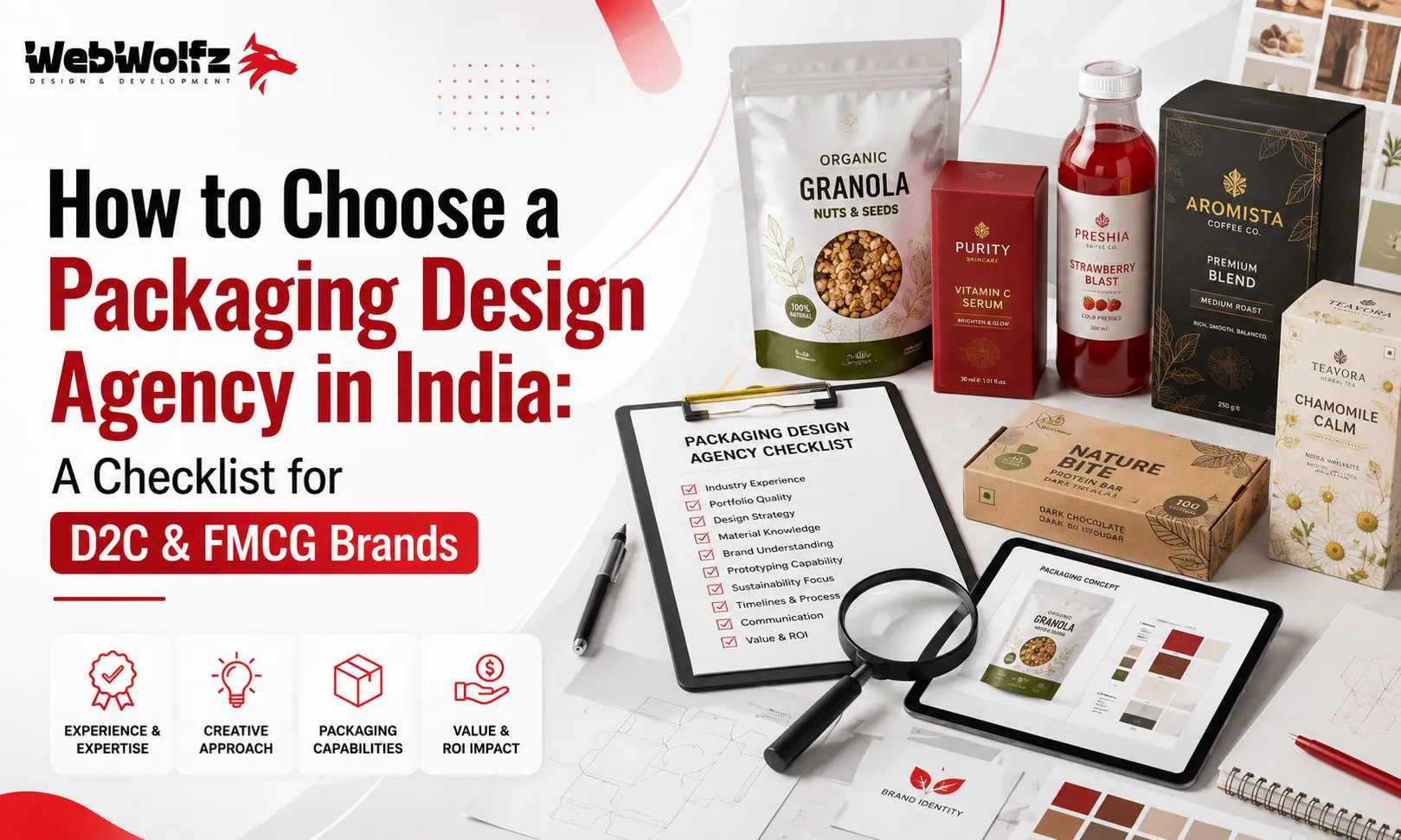
Your packaging is not just a wrapper. It is the first thing a customer sees on a retail shelf, on a Blinkit listing, or when they tear open a delivery box. For D2C and FMCG brands operating in India’s fast-moving consumer market, the packaging design decision is one of the highest-impact brand investments you will make. Yet most founders rush into it without a proper evaluation process. They hire an agency based on a referral, or pick someone cheap from a freelance platform, and end up with files that their printer cannot use or a design that looks nothing like the category they are competing in.
This blog is your step-by-step checklist for choosing the right packaging design agency in India. Whether you are launching your first SKU in the snacks segment, refreshing a wellness drink lineup, or scaling an FMCG portfolio into modern trade, this guide will help you ask the right questions and avoid costly mistakes.
Why Getting This Decision Right Matters More Than You Think
Studies suggest that nearly 72% of consumers say packaging design influences their purchase decisions, especially in competitive retail and e-commerce environments. India’s D2C and FMCG sectors are growing faster than ever, and the shelf, whether physical or digital, is more crowded than it has ever been. A well-designed package communicates your brand’s personality, builds instant trust, and can often be the deciding factor between your product and a competitor’s sitting right next to it. FruitBowl Digital
The problem is that great-looking packaging on a designer’s screen does not always translate into great packaging in real life. If the agency does not understand dieline structures, CMYK colour profiles, print bleed specifications, and FSSAI compliance requirements, you will spend more money fixing problems than you saved by hiring cheap. This is why a structured evaluation process is not optional, it is essential.
Step 1: Check If They Understand Your Category
The first thing you should do before even looking at pricing or timelines is evaluate the agency’s category experience. There is a significant difference between an agency that has designed packaging for a luxury candle brand and one that has worked extensively in food, snacks, beverages, or health products.
If you are launching a protein snack or a hydration drink, you want an agency that knows how those categories communicate visually, what conventions exist on shelf, and how to stand out without confusing the consumer. For example, if you look at how protein snack packaging design works across the category, you will notice a very specific visual language around bold typography, high-contrast colour blocking, and ingredient callouts. An agency unfamiliar with this language will design something generic that does not resonate with your target audience.
Similarly, snack brands launching flavours like peri peri chips or potato chips need packaging that communicates heat, crunch, and indulgence through visual cues that shoppers in India recognise instantly. Category knowledge is not a bonus, it is the baseline.
Ask the agency directly: what food and FMCG brands have you worked with? Can you share three packaging projects in my product category? If their portfolio is mostly lifestyle, apparel, or SaaS brands, move on.
Step 2: Evaluate the Portfolio for Depth, Not Just Aesthetics
A portfolio full of pretty mockups is not the same as a track record of effective packaging. When you review an agency’s work, you need to look beyond the visual appeal and ask harder questions.
First, does the portfolio show consistency across multiple SKUs? A brand that sells ten flavours of roasted nuts needs packaging that looks like a family, not ten separate products designed by ten different people. If the agency’s portfolio only shows one-off hero projects, they may not have experience building scalable packaging systems. This matters a lot for FMCG brands that plan to expand their range.
The best packaging design companies in India treat packaging as a commercial tool, not a canvas. They start from brand strategy and category research, not from jumping straight to visuals. Look for agencies that talk about shelf visibility, consumer psychology, and purchase triggers when they describe their work, not just the color palette they chose. Miraclestudio
Second, check if the portfolio includes real-world outcomes. Did the packaging they designed actually make it to shelves or e-commerce listings? Can they share any brand that is currently selling with packaging they designed? Real-world deployment is proof that their files were print-ready and production-worthy, not just render-worthy.
Step 3: Ask About the End-to-End Process, Not Just the Design Phase
One of the most overlooked factors when evaluating a packaging design agency in India is their production knowledge. A lot of agencies are strong at concept and visual design but weak at the technical execution that gets packaging to a printer without rework, delays, or reprints.
Before you hire anyone, ask them to walk you through their process from brief to final file delivery. A good agency should be able to speak confidently about dieline creation, bleed margins, print-ready file formats like AI, PDF, EPS, CMYK versus Pantone colour specifications, and how they handle FSSAI label compliance for food brands.
A reliable agency delivers fully print-ready packaging files including dielines, artwork in AI, PDF, and EPS formats, CMYK colour profiles, bleed and trim specifications, and barcode-ready layouts, which is everything required for direct handover to print production. If the agency you are speaking to cannot explain any of these things in clear terms, that is a serious red flag. UnFoldMart
For food and beverage brands specifically, FSSAI compliance is non-negotiable. Your packaging must carry the correct nutritional information, ingredient listing, allergen declarations, manufacturing details, and net weight, all formatted correctly. An agency that has never worked with food brands may design something visually strong but legally incomplete, which means you cannot legally sell your product until everything is corrected.
This is where agencies with deep food packaging experience genuinely save you time and money. Check out how proper food packaging design balances visual appeal with regulatory requirements. Brands launching products like electrolyte powders or protein shakes face even more detailed requirements around health claims and nutritional panels, and getting those wrong can hold up your entire launch.
Step 4: Understand How They Approach Brand Strategy
Packaging design is not just about making something look good. It is about making something that communicates your brand promise in under three seconds. The best agencies start with strategy, not software.
When you speak to a potential agency, ask them how they begin a new packaging project. Do they ask you about your target consumer, your price positioning, your retail channel, and your competitors? Or do they ask for your logo, your colour preferences, and your deadline? The questions an agency asks in the first meeting tell you everything about how they think.
A strategy-first agency will want to understand whether your product lives on a quick commerce platform like Blinkit or Zepto, in a modern trade store like BigBasket or D-Mart, or in a D2C unboxing context. Each channel has different visual requirements. Packaging studios understand how a pack photographs, how it reads at thumbnail size, and what creates an unboxing moment worth sharing. These are considerations that only come from experience with the specific channels your product operates in. Miraclestudio
For emerging categories like makhana, popcorn, or flavoured nuts, the strategic question is often about how to communicate a health benefit while still feeling indulgent and aspirational. Getting that balance right requires strategic thinking, not just design execution.
If you are a startup or a newer D2C brand, this matters even more. There is a useful perspective on snack packaging design for startups that explains why early-stage brands need to be especially intentional about how their packaging positions them in the market from day one.
Step 5: Clarify Timelines, Revisions, and What Is Actually Included
Many packaging projects go sideways not because of poor design but because of unclear scope agreements. Before you sign anything, get explicit answers to the following questions.
How many initial concepts will they present? Some agencies present two concepts, some present five. More concepts give you more direction to choose from, but also cost more time. Understand what you are getting.
How many rounds of revisions are included in the project cost? A revision round typically means one consolidated set of changes. If you give ten separate pieces of feedback over four emails and expect them all to count as one revision, that is a misunderstanding that will create friction later.
What exactly will they deliver at the end? The final file package should include the master design file in an editable format, print-ready PDFs with proper bleed and crop marks, the dieline template, colour specifications in both CMYK and Pantone where applicable, and ideally a mockup for your website and social media. If an agency is vague about deliverables, get it in writing before you start.
Also ask about turnaround time specifically. The average packaging design project for a single SKU with two or three concepts and two revision rounds typically takes three to six weeks. If an agency promises you something polished in five days, either the work will be templated or the revision process will be rushed.
For categories with multiple variants, like a chips seasoning line or a seasoning pouch range, make sure the agency has a clear process for building packaging systems where every variant feels cohesive. This requires a slightly different workflow than designing a single standalone pack.
Step 6: Look at Client Relationships, Not Just Client Logos
Agency decks are full of impressive brand logos. But a logo on a slide does not tell you whether the client was happy with the experience, whether the project came in on time and on budget, or whether the packaging actually performed in market.
Ask for references you can actually speak to. Ask the agency to connect you with one or two past clients in a similar industry so you can have a ten-minute call and ask real questions. Most credible agencies will not hesitate to do this.
Also pay attention to how the agency communicates with you during the evaluation stage. Are they responsive? Do they ask thoughtful questions? Do they send over a clear proposal that shows they understood your brief? The way an agency treats you before you hire them is a preview of how they will treat you after you pay them.
Look for agencies that have a documented process, clear communication channels, and a track record of clients who came back for multiple projects. Repeat business is the strongest signal that an agency delivers on its promises. If you are considering packaging design services for food brands, this kind of agency vetting is especially important because food brands often need to update packaging seasonally, add variants, or create limited edition packs, which means you need a long-term partner, not a one-time vendor.
Step 7: Understand Pricing Without Making It the Only Deciding Factor
Packaging design pricing in India varies enormously. You will find freelancers charging five thousand rupees per label and specialist agencies charging two to five lakh rupees for a full brand and packaging system. Both exist for a reason, and the right budget depends entirely on the stage you are at and the stakes involved.
For a D2C brand launching on Instagram and Shopify with a small initial run, a mid-range studio that delivers strong design and proper print-ready files is usually the right fit. For an FMCG brand entering modern trade, the investment in a specialist agency that understands shelf visibility, planogram placement, and category conventions is almost always worth it.
The real cost to watch out for is not the design fee but the cost of getting it wrong. Reprinting packaging because of a technical file error, correcting FSSAI labelling issues after the first batch, or redesigning because the packaging looked nothing like the category, these are the expenses that actually hurt. A slightly higher design investment that gets it right the first time is almost always cheaper in the long run.
Also understand what is included in the quoted price. Some agencies quote a design fee that excludes mockups, dielines, or print consultation. Others include everything in a single project cost. Ask for a detailed scope document before you compare prices across agencies.
For niche wellness and functional products like collagen water, energy gel sachets, or hydration multiplier drink mixes, the packaging needs to do a lot of heavy lifting in educating the consumer while still looking premium. Under-investing in design for these categories often means consumers walk past without understanding what the product even does.
Step 8: Assess Digital-First Capabilities
This point gets overlooked far too often. In 2025 and 2026, a large percentage of FMCG and D2C sales happen through quick commerce, marketplaces, and brand websites. That means your packaging will be seen as a small product image on a phone screen before it is seen in person.
An agency that only thinks about how packaging looks on a shelf and not how it reads as a 200×200 pixel thumbnail is not keeping up with how Indian consumers actually shop today. Your packaging needs to be legible, impactful, and brand-consistent even at very small sizes.
Beyond the thumbnail question, D2C brands need to think about the unboxing experience. For D2C and e-commerce brands, the unboxing moment is the physical brand experience, the first time your customer interacts with your product in three dimensions. Packaging designed for the unboxing experience generates social sharing, repeat purchase, and word-of-mouth acquisition that no paid channel can replicate at the same cost. Maddog Global LLP
Ask the agency how they approach digital-first packaging. Do they test their designs at thumbnail scale? Do they think about secondary packaging like mailer boxes or tissue inserts? Do they design with social media photography in mind? These capabilities separate agencies that are genuinely built for the current market from those that are still thinking about packaging as a purely physical medium.
For beauty and wellness brands working with products like beauty water bottles or protein drinks, digital aesthetics are central to the brand identity. The packaging is essentially a prop in every Instagram post, every YouTube review, and every influencer unboxing. It needs to photograph beautifully, not just look good in real life.
A Note on Doing All of This Yourself vs. Finding the Right Partner
If you have read through this entire checklist, you will notice that evaluating a packaging design agency properly requires a significant amount of time and effort. You need to review portfolios, schedule multiple calls, check references, compare proposals, and verify technical capabilities, all before a single design concept is even created.
For founders and brand managers who are already managing product development, supply chain, marketing, and sales, this evaluation process can feel overwhelming. That is where working with an agency that has already proven itself across multiple food, snack, and wellness categories makes the whole process much simpler.
WebWolfz is a packaging design studio that has worked across a wide range of food and FMCG categories, from extruded snacks and frozen french fries to protein brownies, protein cookies, protein muffins, and functional coffee. Instead of spending weeks on the evaluation process only to start from scratch with a new agency, brands that work with WebWolfz get category knowledge, strategic thinking, and print-ready execution all in one place.
If you are looking for a packaging design agency in India that understands D2C and FMCG brands from the inside out, you can get in touch with the WebWolfz team here and discuss your project directly.
Closing Thoughts: Use the Checklist, Then Trust Your Gut
Choosing the right packaging design partner is both a logical decision and an intuitive one. The checklist above covers the logical side: category experience, portfolio depth, process clarity, technical capability, and communication quality. But once you have shortlisted two or three agencies that tick all the boxes, the final decision often comes down to which team you felt understood your brand the most.
Good packaging design is a collaboration. The agency needs to understand your vision, and you need to trust their expertise. When both of those things are true, the output tends to be packaging that genuinely performs, whether it is sitting on a shelf in a D2C store, appearing in a quick commerce search result, or being filmed for an unboxing reel.
Take your time, use this checklist, and invest in the right partner from the start. Your packaging is often the only salesperson your product has.
https://webwolfz.com/wp-content/uploads/2026/07/closing-thoughts-webwolfz.pdf
Frequently Asked Questions
1. How do I know if a packaging design agency in India has experience with my product category?
Ask them directly to share three to five packaging projects from your specific category, whether that is snacks, beverages, wellness, or personal care. If they cannot show you relevant work, their general design skills may not translate to your specific shelf context. Category knowledge affects everything from colour strategy to typography choices to the placement of claims and nutritional panels.
2. What is the average cost of hiring a packaging design agency in India?
Pricing varies widely. Freelancers may charge anywhere from five thousand to thirty thousand rupees per SKU, while specialist packaging studios typically charge between fifty thousand and five lakh rupees depending on the project scope, number of SKUs, and level of strategic involvement. The right budget depends on your stage, sales channel, and how much commercial weight your packaging needs to carry.
3. What files should a packaging design agency deliver at the end of a project?
At minimum, you should receive print-ready PDF files with proper bleed and crop marks, the editable master design file in Adobe Illustrator format, the dieline template, CMYK and Pantone colour specifications, and high-resolution mockups for digital use. If the agency delivers only a JPEG or a Canva export, you do not have production-ready files.
4. How long does a packaging design project typically take in India?
A single SKU with two to three initial concepts and two rounds of revisions usually takes three to six weeks from brief to final file delivery. More complex projects involving multiple SKUs, packaging systems, or structural dieline development can take eight to twelve weeks. Rush timelines are possible but often affect the quality of strategic thinking in the early stages.
5. Is FSSAI compliance something the packaging design agency handles?
A good food packaging design agency will know what information is legally required on your label and how it needs to be formatted. However, the actual regulatory compliance responsibility sits with the brand owner. The agency should flag requirements and design the layout accordingly, but you should verify all claims, ingredient lists, and declarations with a regulatory consultant or your own legal team before going to print.
6. Can the same packaging design agency work for both my D2C online channel and modern trade retail?
Yes, but make sure the agency explicitly understands the differences between the two channels. Modern trade packaging is designed for shelf standout at eye level, while D2C packaging needs to photograph well on white backgrounds, read clearly at thumbnail size, and create a strong unboxing experience. The best agencies design with both contexts in mind from the start rather than treating them as separate briefs.
7. What should I do if I am not happy with the initial concepts an agency presents?
This is normal and part of the process. Before rejecting concepts outright, try to articulate specifically what is not working, whether it is the colour, the hierarchy, the tone, or the category fit. Clear, specific feedback leads to much better second rounds than vague dissatisfaction. If after two full revision rounds the work still feels misaligned, it may indicate a strategic misunderstanding at the brief stage rather than a pure execution problem.