

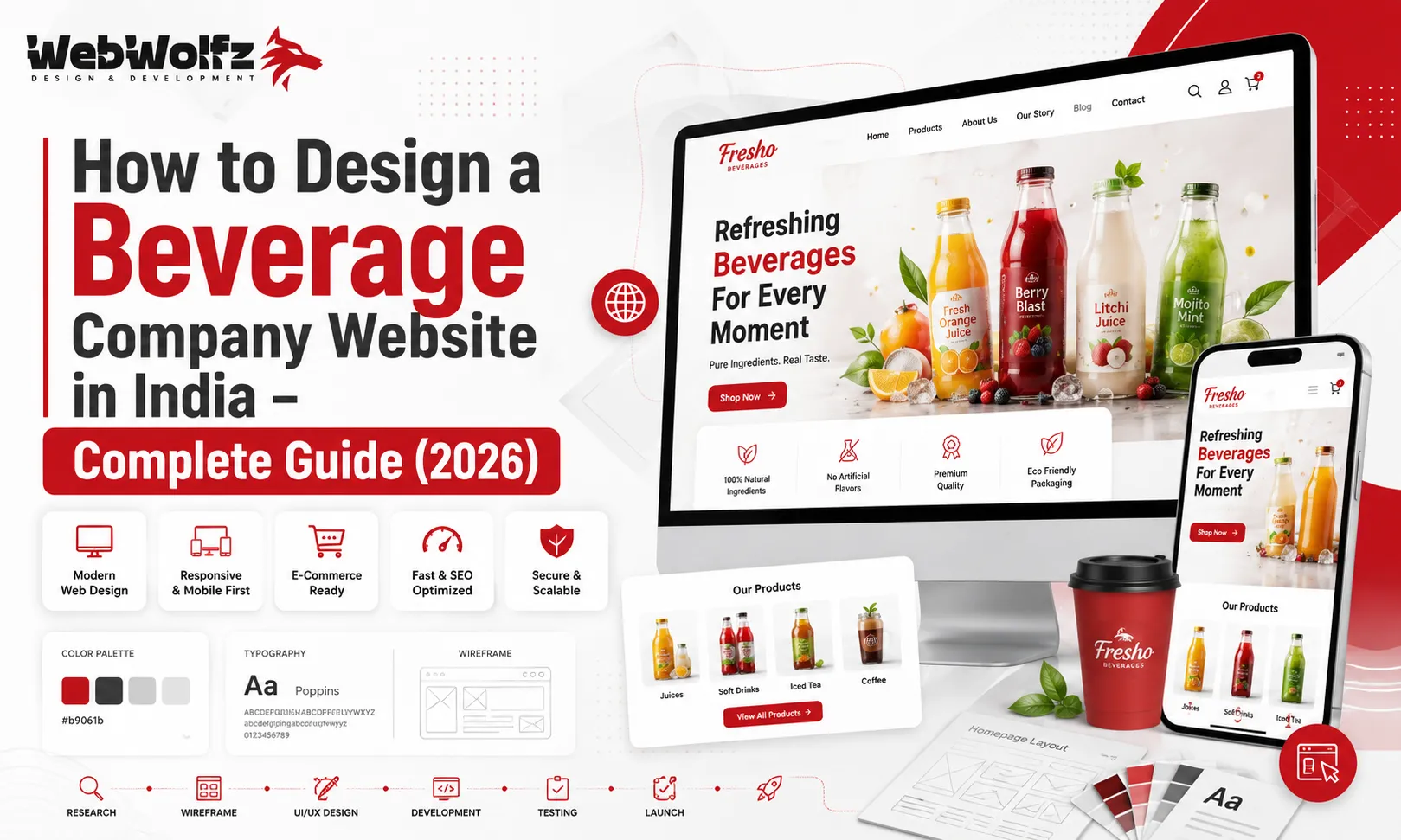
India’s beverage market is growing at a pace that most founders did not expect just a few years ago. Energy drinks, protein shakes, hydration powders, flavoured waters, functional coffees — new categories are launching every quarter. And every single one of these brands needs a website that does more than just look good. It needs to rank on Google, convert visitors into buyers, and represent the brand at its absolute best. Yet most beverage founders either delay building their website or hand it to the cheapest developer they can find — and then wonder why their organic sales never take off.
If you are building a beverage brand in India in 2026, this guide will walk you through everything you need to know about beverage company website design India — from the pages your site must have, to SEO, to mobile experience, to the one decision that can save you six months of frustration.
Why Your Beverage Brand Needs a Proper Website in 2026
Let us start with a simple reality. More than 80 percent of online shoppers in India begin their product discovery on Google before they click a paid ad or open any marketplace. That means your website is not just a brochure — it is your primary sales and trust-building tool. If someone discovers your protein drink on Instagram and then searches your brand name, they will land on your website. What they see in the next five seconds determines whether they buy or bounce.
A well-designed food beverage website development project is not just about colour palettes and fonts. It is about building a system where your product pages rank on Google, your brand story builds emotional connection, and your checkout process removes every possible friction. The brands that are winning in India right now — think Paper Boat, Bombay Sodaworks, Lahori Zeera, or newer D2C hydration players — all have websites that feel premium, load fast, and give the visitor exactly what they need without confusion.
The global F&B ecommerce market is projected to cross $894 billion in 2026. Indian brands that do not have a high-performing digital presence will simply hand that growth to someone else. Your website is where that battle is won or lost.
Step 1 — Define Your Website Goal Before Anything Else
Before you open WordPress or talk to a developer, you need to answer one question clearly: what is this website supposed to do? Most beverage founders confuse this step and end up building something that tries to do everything but does nothing well.
Your beverage website can serve one of a few primary purposes. It can be a D2C ecommerce store where customers buy directly. It can be a brand discovery website that builds trust and pushes customers toward retail or quick commerce. It can be a B2B-facing site that talks to distributors and modern trade buyers. Or it can be a combination — which most established brands eventually need.
Your goal decides your platform, your page structure, your content strategy, and your budget. A D2C ecommerce site needs Shopify or WooCommerce with proper checkout flows. A brand discovery site can run on WordPress with a clean theme. A B2B-facing site needs a different tone, a different homepage, and a different contact flow entirely. Getting this wrong at the start means rebuilding everything in six months — which happens more often than most agencies will tell you.
Step 2 — Pages Your Beverage Website Must Have
Once your goal is clear, the next step is building the right page structure. Most beverage brands make the mistake of copying a generic ecommerce template without thinking about what their specific audience actually needs to see.
Your homepage should communicate your brand positioning in under five seconds. Visitors should immediately understand what you sell, who it is for, and why they should care. Use your strongest product visual on the hero section — not a lifestyle shoot of people laughing on a beach. Your product range, a short brand statement, and a clear CTA to shop or explore should all sit above the fold. Research consistently shows that the homepage is where trust is either built or destroyed, and beverage brands especially need strong visual storytelling here because the product itself is the experience.
Your product pages are where conversions actually happen. Each product should have its own dedicated page with a unique title, a detailed description that naturally includes your target keyword, high-quality product images from multiple angles, and a clear list of ingredients and nutritional information. Indian consumers in 2026 are far more ingredient-conscious than they were even two years ago — especially in categories like protein drinks, hydration powders, and electrolyte drinks. Transparency on your product page is not optional — it is conversion.
Your About page matters more for beverage brands than for almost any other category. People drink what they trust. Your origin story, your sourcing philosophy, your team, and your brand values all belong on a well-crafted About page. This page also tends to rank well for branded searches, which means it directly affects your ability to capture word-of-mouth traffic.
An FAQ page is underrated by most founders but Google loves it. A well-structured FAQ page with schema markup can appear as rich results in Google search — taking up significantly more screen space and driving higher click-through rates. Include questions about your ingredients, shelf life, delivery timelines, returns policy, and anything else your customer service team gets asked repeatedly. This single page can reduce support queries by thirty percent while simultaneously helping your organic rankings.
A blog section is non-negotiable if you want organic traffic. Beverage brands that publish consistent, keyword-targeted blog content build domain authority over time — and domain authority is what allows your product pages to rank. Think about the questions your customer actually asks before buying: “best hydration drink for gym,” “electrolyte powder without sugar India,” “protein shake for weight loss,” and so on. Each of those is a blog article that drives qualified traffic. If you have multiple product lines — say you also carry energy gels or collagen water — each category deserves its own cluster of supporting content.
A Contact page with a simple form, your city, your email, and optionally a WhatsApp link is essential. Many D2C beverage founders underestimate how many B2B opportunities — distributors, hotels, gyms, corporate canteens — come through a contact page that looks credible and professional.
Step 3 — Mobile First Is Not a Suggestion, It Is the Rule
In India, over seventy percent of web traffic comes from mobile devices. For beverage and food brands specifically, that number is even higher because most discovery happens on Instagram and YouTube — both of which are mobile-first platforms. When someone sees your Reels ad and taps through to your website, they land on a mobile browser. If your site takes more than three seconds to load or if your navigation is clunky on a five-inch screen, they are gone.
Your developer must test every single page on both Android and iOS devices at multiple screen sizes. Menus must be easy to tap. Product images must load quickly. The add-to-cart button must be prominent and reachable with one thumb. Checkout must not require more than three steps. These are not nice-to-haves — they directly determine your conversion rate.
Page speed is also a ranking factor. Google’s Core Web Vitals measure how fast your pages load, how stable the layout is while loading, and how quickly users can interact with the page. A beverage brand website with beautiful imagery that loads in six seconds will rank below a competitor with decent imagery that loads in two seconds. Compress your images, use a proper CDN, and choose a hosting plan that can handle traffic spikes — especially important during festive sales and launch campaigns.
Step 4 — SEO for Beverage Brand Websites in India
Building a beautiful website that nobody finds is one of the most common and costly mistakes in D2C. Beverage company website design India in 2026 must be built with SEO baked in from day one — not bolted on as an afterthought after launch.
Start with keyword research specific to your product category. If you sell protein shakes, your keyword universe is different from someone selling functional coffee or hydration multiplier mixes. Use tools like Google Search Console, Google Keyword Planner, or Ahrefs to identify what your potential customers are actually searching for. Long-tail keywords with clear buying intent — “best electrolyte drink for runners India” or “sugar free protein shake India” — are far easier to rank for than generic head terms, especially if your website is new.
Every product page needs a unique title tag, a unique meta description, and a unique H1 heading. Never use the same meta description across multiple product pages — Google treats that as thin content and it will suppress your rankings. Your product descriptions must be written in your own words and must not be copied from your manufacturer or any other website. Duplicate content is one of the fastest ways to get suppressed in Google search results.
Structured data, also called schema markup, is especially important for beverage and food websites in 2026. Product schema with price, availability, and reviews helps Google display rich results with star ratings and pricing directly in the search results — which can increase your click-through rate by thirty to fifty percent according to multiple studies. FAQ schema on your FAQ page and blog posts helps your content appear as featured snippets. If you have recipes on your site, Recipe schema can put your content directly in the recipe carousel at the top of Google.
Internal linking is how you pass authority from your strong pages to your newer pages. If you publish a blog post about packaging design for your protein drink, link from it to your product page. If you write about electrolyte powder packaging, link to your hydration product page. This creates a web of relevance that Google’s crawlers follow to understand what your site is about — and to rank your pages accordingly.
Your beverage brand’s logo and visual identity feed into your website’s overall credibility. A professional beverage logo design used consistently across your website, your packaging, and your social channels creates brand recognition that compounds over time. If your logo looks like it was made in five minutes, visitors will assume your product is similarly rushed — no matter how good it actually tastes.
Step 5 — Design Principles That Actually Sell Beverages Online
Design for beverage brands is not the same as design for SaaS companies or consultancies. Your product is sensory — it is about taste, freshness, energy, health, indulgence. Your website design must evoke those same feelings before the customer ever opens a bottle.
Color psychology matters enormously in the beverage space. High-energy brands — think sports hydration or pre-workout drinks — typically use bold neons, deep blacks, and high-contrast typography. Health and wellness brands lean toward greens, whites, and earthy neutrals. Indulgent brands — craft sodas, flavoured sparkling waters — often use playful, vibrant palettes. Your design choices must match the emotion your product is trying to create.
Photography is the single biggest differentiator between a beverage website that converts and one that does not. Professional product photography — showing condensation on a bottle, ingredients being poured, the drink in a lifestyle context — creates the sensory trigger that makes someone click buy. Do not use stock photography for your hero images. Invest in a proper product photoshoot. It will pay back many times over in conversion rate.
Typography, white space, and layout hierarchy all work together to guide the visitor’s eye from arrival to purchase. Your most important message should be the largest and most prominent. Secondary information — flavours, pack sizes, subscription options — should be clearly accessible but not competing with your primary CTA. Clutter kills conversions. The best drink brand websites in 2026 are clean, fast, and visually confident.
Your beverage packaging design and your website design must feel like they come from the same world. When someone picks up your bottle at a shelf and then visits your website, the experience should be consistent. If your packaging is bold and edgy but your website looks corporate and dull, you have a brand disconnect that erodes trust. This is why brands that invest in cohesive design — packaging, logo, and website all aligned — tend to build faster recognition and loyalty.
Step 6 — Technical Checklist Before You Launch
A technically broken website will not get indexed properly by Google — which means all your content and design effort is wasted. Before you go live, run through this checklist carefully.
Make sure your website has an SSL certificate — the padlock in the browser address bar. Google has confirmed that HTTPS is a ranking signal, and more importantly, Indian consumers in 2026 will immediately distrust any website that shows “Not Secure” in the browser. Your hosting provider should offer SSL for free on any modern plan.
Submit your XML sitemap to Google Search Console the day you launch. Your sitemap tells Google exactly which pages you want indexed and in what order of priority. Without a sitemap submission, Google will eventually crawl your site on its own — but it may take weeks or months, and it may miss pages. With a sitemap, indexing typically begins within forty-eight to seventy-two hours of submission.
Check that your robots.txt file is not accidentally blocking important pages. This is a surprisingly common mistake — a developer sets up a staging website with noindex rules to stop Google from crawling an unfinished site, and then forgets to remove those rules before launch. Use Google Search Console’s URL Inspection tool to verify that your key pages are indexable immediately after launch.
Set up Google Analytics 4 and Google Search Console on day one. These two tools together give you everything you need to understand where your traffic is coming from, which pages are ranking, which queries are driving impressions, and where visitors are dropping off. Without this data, you are flying blind.
Canonical tags must be correct on every page — especially if you have product variants (different flavours of the same drink, for example). If you have both webwolfz.com/product/mango-drink and webwolfz.com/product/mango-drink?color=yellow indexable by Google, you are splitting your link equity across duplicate pages. Canonical tags consolidate that equity onto your preferred URL.
Your website’s 404 page should be custom-designed and should offer navigation back to your key pages. A standard server 404 page makes your brand look unprofessional and loses visitors who might have recovered with a gentle nudge toward your best products.
Step 7 — Hiring the Right Agency vs Building In-House
This is where most beverage founders spend the most time agonising — and the answer is simpler than it seems. If you have a strong in-house developer who understands both UX and SEO, building in-house can work. But if you are a founder whose core strength is the product, the flavour, the distribution — not the code — then hiring an experienced agency is almost always the faster and more cost-effective path.
The right agency for a drink brand website is not just one that makes things look nice. They need to understand food and beverage branding specifically, because the visual language of this category is different from tech or finance. They need to understand Indian D2C ecommerce — payment gateways like Razorpay and Cashfree, COD logic, Shiprocket or Delhivery integration, and how Indian shoppers behave differently from Western shoppers. And they need to understand SEO from the ground up — not as a separate service sold after the website is built, but as something woven into every page, every title tag, and every content decision from day one.
If you are also looking for help beyond the website — understanding how your packaging design connects to your digital presence, how to choose the right visual identity for your category, or even how to choose the right packaging design agency in India — those decisions compound into your website’s success as well. Your packaging is your offline advertisement. Your website is your online store. They must work together.
A team like WebWolfz understands this connection deeply. Rather than spending months going back and forth with a developer who does not understand beverage branding, or paying separately for a design agency, an SEO consultant, and a developer — working with a studio that handles the complete picture from brand identity to web development means your website launches faster, looks better, and actually ranks. If you are ready to build or rebuild your beverage brand’s digital presence, you can reach out to WebWolfz here.
Common Mistakes Indian Beverage Brands Make With Their Websites
The first and most common mistake is launching without a blog or content strategy. A website without content is a dead end for organic traffic. Every competitor who publishes consistent, relevant blog content is building domain authority that will rank them above you for years.
The second mistake is using a single-page or very thin website — just a home page, a shop link, and a contact page. Thin websites give Google very little to index and very little reason to send you organic traffic.
The third mistake is ignoring the connection between packaging and web design. Indian founders often treat these as completely separate projects — but a consumer who sees your food packaging design on a shelf and then searches your brand online expects visual consistency. Discontinuity creates doubt.
The fourth mistake is choosing a website platform that cannot scale. Building on a platform that works for fifty products but breaks at five hundred, or that cannot handle a thousand concurrent visitors during a festive sale, is a decision you will pay for later. Plan for where you want to be in two years, not just where you are today.
The fifth mistake — and perhaps the most quietly damaging — is launching a beautiful website with no plan for driving traffic to it. SEO takes time. Paid ads cost money. Social traffic is inconsistent. The brands that grow sustainably are the ones who invest in all three in parallel from day one, not sequentially.
Launch Timeline: What to Expect
A properly built beverage brand website — with ecommerce functionality, SEO-optimised content, and a solid technical foundation — takes between six to twelve weeks to build correctly. Founders who try to rush this to four weeks typically end up with something that needs to be rebuilt within a year. Invest the time upfront. The SEO benefits of getting it right on launch — versus launching broken and fixing later — are significant, because Google’s initial crawl of your website shapes how it categorises your domain for months.
In the first month after launch, focus on getting all key pages indexed via Google Search Console, submitting your sitemap, and building your first few backlinks through PR, partnerships, or listing on relevant directories. In months two and three, focus on publishing your first batch of blog content targeting long-tail keywords in your category. From month four onwards, you should begin seeing organic impressions growing in Search Console — and that is when the compounding begins.
FAQ
Q1. How much does it cost to build a beverage company website in India?
The cost depends heavily on what you need. A basic brand discovery website built on WordPress or Webflow can cost anywhere from Rs. 30,000 to Rs. 80,000. A fully functional D2C ecommerce website with payment gateway integration, product pages, blog, and SEO setup typically ranges from Rs. 80,000 to Rs. 2,50,000 or more depending on the agency and scope. Avoid the temptation to go with the cheapest option — a poorly built website will cost you far more in lost sales and rebuilding costs than the money you saved upfront.
Q2. Which platform is best for a beverage brand website in India — Shopify or WordPress?
Both platforms are used by successful beverage brands in India. Shopify is generally better for pure-play D2C ecommerce because its checkout flow is faster to set up, it integrates easily with Indian payment gateways, and it handles inventory management well. WordPress with WooCommerce gives you more flexibility for content-heavy websites and is better for SEO in the long run if set up correctly. The right choice depends on your technical team’s capacity and how much of your revenue model depends on direct online sales versus brand building.
Q3. How long does it take for a new beverage website to rank on Google?
For most new beverage websites in India, it takes three to six months to start seeing meaningful organic traffic — provided you have set up SEO correctly from day one, are publishing consistent blog content, and are building backlinks gradually. Highly competitive keywords like “protein drink India” may take twelve months or longer. Long-tail keywords like “best electrolyte drink for cycling India” can rank within sixty to ninety days if your content is well-optimised and your technical SEO is clean.
Q4. Do I need a separate mobile app for my beverage brand, or is a website enough?
For most early-stage and mid-stage beverage brands in India, a well-optimised mobile website is enough. Mobile apps make sense once you have a large repeat-purchase customer base and the resources to maintain the app. A Progressive Web App (PWA) is a good middle ground — it gives users an app-like experience on mobile without the cost and complexity of building a native iOS or Android app.
Q5. How important is packaging design for a beverage brand’s website performance?
Very important — though the connection is indirect. Your packaging is often the first physical touchpoint a customer has with your brand. When they then visit your website, visual consistency between your packaging and your web design builds instant credibility and trust. Brands that invest in cohesive design across both touchpoints consistently see higher conversion rates on their websites than brands where packaging and web design feel disconnected.
Q6. What pages should a beverage brand website always have?
At minimum: a homepage, individual product pages for each SKU, an About page with your brand story, an FAQ page with schema markup, a blog section with keyword-targeted content, and a Contact page. If you are selling D2C, you also need a proper cart and checkout flow, a Shipping and Returns page, and a Privacy Policy page — the last two are also required by Google for ad accounts to function.
Q7. How do I make sure my beverage website gets indexed quickly by Google?
Submit your XML sitemap to Google Search Console immediately after launch, use the URL Inspection tool to request indexing for your key pages, make sure your robots.txt is not blocking any important pages, ensure your site loads in under three seconds on mobile, and publish at least three to five pieces of original content before launch so Google has something substantial to index. Avoid noindex tags on any page you want to rank.