

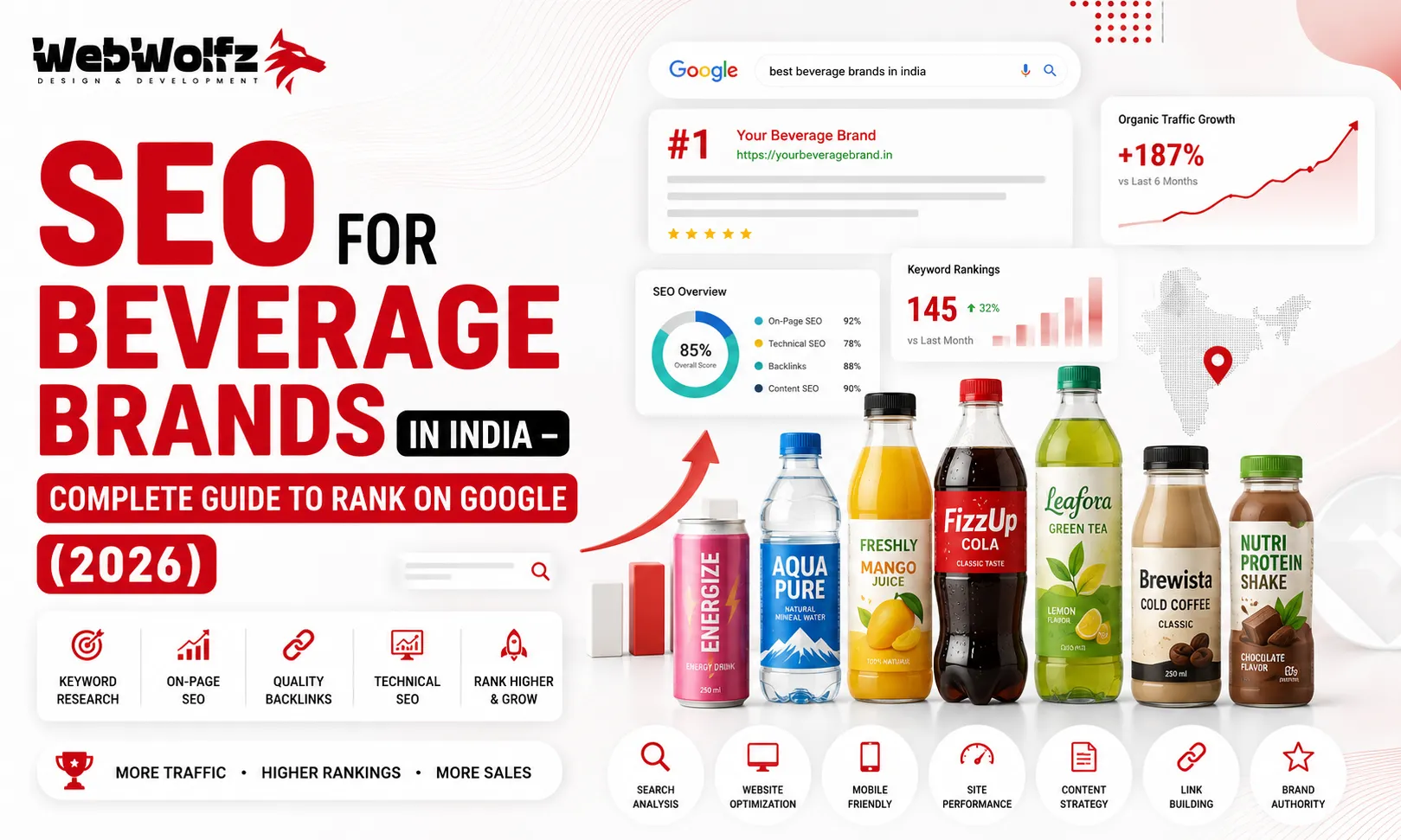
India’s beverage market is booming. From protein shakes and electrolyte drinks to craft juices and functional waters, new brands are launching every month. But here is the hard truth: having a great product is not enough anymore. If your brand is not showing up on Google when someone searches for it, you are handing that customer directly to your competitor.
This is where SEO for beverage company India becomes your single most important long-term investment. Unlike paid ads that stop the moment your budget runs out, a well-executed SEO strategy keeps bringing in traffic, builds your brand credibility, and compounds over time. The question is not whether your beverage brand needs SEO. The question is whether you are doing it right.
This guide walks you through everything — from keyword research and on-page optimization to technical fixes and content strategy — specifically built for the Indian beverage market in 2026.
Why SEO Is Non-Negotiable for Beverage Brands in India
Think about how a retailer, distributor, or end consumer discovers a new beverage brand today. They Google it. According to recent data, India crossed 800 million internet users in 2025, and Google holds over 97% of the search market in the country. If your brand does not appear in the top results, it effectively does not exist for that searcher.
The beverage category is particularly competitive. You are not just competing with brands in your city. You are competing nationally, and in some cases, with international brands that have massive SEO budgets. That makes it even more critical for emerging Indian beverage brands to build a smart, focused SEO foundation before trying to scale.
Beyond visibility, there is a trust element. When a buyer searches “best electrolyte drink India” or “whey protein drink brand India” and your brand appears organically in the top results with a well-designed website, it signals authority. Organic rankings are earned, not bought, and consumers know that. A strong SEO presence tells the world that your brand is credible and worth considering.
It also helps that beverage brands have an enormous amount of visual and educational content to work with. Your packaging design, your formulation story, your ingredient sourcing, your target audience — all of this can be turned into SEO content that ranks and builds your brand simultaneously.
Step 1: Keyword Research for Beverage Brands in India
The foundation of any good SEO strategy is understanding what your potential customers are actually typing into Google. For a beverage brand in India, this means thinking in layers.
Start with your core category keywords. If you sell protein drinks, your primary keywords might be “protein drink India,” “best protein shake for gym,” or “whey protein beverage brand India.” If you sell electrolyte powders, you are looking at terms like “electrolyte drink India,” “ORS alternative India,” or “hydration drink for athletes India.” These are your primary keywords and they tend to be competitive.
The real opportunity for most growing beverage brands lies in long-tail keywords. These are more specific phrases that have lower competition but higher buying intent. For example, “sugar-free electrolyte drink for runners India” or “best hydration powder for summer India” or “vegan protein drink brand India.” These kinds of searches come from people who are much closer to making a purchase decision, which means they convert better.
You should also do competitor keyword research. Look at what terms the top three or four beverage brands in your category are ranking for, identify the gaps, and build content around those gaps. Tools like Google Search Console, Ubersuggest, Ahrefs, or even Google’s own autocomplete feature are good starting points for this.
Do not ignore regional searches either. India is a multilingual country. Someone in Gujarat might search in Gujarati, someone in Tamil Nadu might combine Tamil and English. If your brand serves specific regions, adding Hindi or regional language content — even just the meta tags and product descriptions — can open up a much less competitive ranking opportunity that most brands completely ignore.
Step 2: On-Page SEO for Your Beverage Brand Website
Once you know your keywords, the next step is making sure your website is properly optimized for them. On-page SEO covers everything that lives on your actual web pages — your titles, headings, meta descriptions, URL structure, content, and internal links.
Your homepage and product pages should have clear, keyword-rich title tags under 60 characters. For example, “Premium Electrolyte Drinks India | BrandName” is clean and optimized. Your meta descriptions under 160 characters should include the keyword naturally and have a call to action. These are not just for Google — they appear in search results and directly influence whether someone clicks on your link or skips it.
Every product page needs unique content. One of the most common mistakes beverage brands make is copying the same description across all their product variants. Google treats duplicate content as a signal of low quality. Write unique descriptions for each SKU, include the specific ingredients, the benefits, who it is for, and how to use it.
Your URL structure matters more than most brands realize. A URL like webwolfz.com/blog/protein-drink-packaging-design is far better than a generic one with numbers or random strings. Clean, keyword-containing URLs are easier for Google to understand and easier for users to remember. If you are redesigning your beverage company website, this is the right time to fix your URL structure from the ground up.
Use your H1 heading for the primary keyword of each page, and use H2 and H3 subheadings for secondary and related terms. This heading hierarchy helps Google understand the structure of your content and what the page is primarily about.
Internal linking is also a critical on-page element that most brands set up incorrectly. Every page on your site should link to other relevant pages. If your protein shake product page mentions packaging, it should link to your packaging information page. If your blog post about hydration drinks mentions your electrolyte powder, link to that product page. This keeps visitors on your site longer and distributes SEO value across your entire site rather than concentrating it on one page.
Step 3: Technical SEO — The Foundation Nobody Wants to Fix
Here is the uncomfortable reality: you can have the best content in the world, but if your website has technical problems, Google will not rank it well. For beverage brands, where the website is often built quickly to support a launch, technical issues are extremely common.
Page speed is the most critical technical factor in 2026. Over 70% of Indian internet users browse on mobile devices, and if your site takes more than three seconds to load, a large portion of your visitors will leave before the page even appears. Google measures this through Core Web Vitals — Largest Contentful Paint, Cumulative Layout Shift, and Interaction to Next Paint. These scores directly influence your rankings. Compress your images, use a fast hosting provider, and if your website runs on WordPress or Shopify, use a caching plugin or app.
Make sure your website is mobile-first in its design, not just mobile-responsive. There is a difference. A mobile-responsive site adjusts to fit a smaller screen. A mobile-first site is designed for mobile from the beginning and then scaled up for desktop. Google uses the mobile version of your site as its primary version for indexing and ranking. If your mobile experience is poor, your rankings will reflect that regardless of how good your desktop site looks.
Structured data markup, or schema, is another technical element that is often overlooked by food and beverage brands. By adding product schema to your product pages, you can potentially get rich snippets in Google results — these show star ratings, prices, and availability directly in the search results page. For a beverage brand competing in a crowded space, a rich snippet can dramatically increase your click-through rate even if you are ranked below a competitor.
Your site should also have a clean sitemap submitted to Google Search Console, no broken links, proper 301 redirects for any changed URLs, and an SSL certificate (the little padlock in the browser). These are basics, but they matter. Google will not confidently index and rank a site that looks technically unreliable.
Canonical tags deserve mention as well. If your product is available in multiple flavors and each flavor has its own page with similar content, use canonical tags to tell Google which version is the primary one. This prevents keyword cannibalization, where your own pages compete against each other in search results.
Step 4: Content Strategy for Beverage Brand SEO
Content is where beverage brands can genuinely separate themselves from the competition. A well-executed content strategy does two things at once: it gives Google more pages to index and rank, and it gives your potential customers genuinely useful information that builds trust in your brand.
The starting point is a blog. Your blog should not just be a place to announce new flavors or post press releases. It should answer the specific questions your target customers are searching for. If you sell hydration drinks, write articles about hydration science, how much water athletes need, what electrolytes actually do, and how to choose a hydration supplement. If you sell protein shakes, write about protein timing, muscle recovery, plant versus whey protein, and ingredient transparency. These are the topics your audience is already searching for, and if you provide genuinely useful answers, Google will rank your content and your brand will be the one they trust when they are ready to buy.
Content clusters are an advanced but highly effective strategy for beverage brands. Instead of writing random blog posts, build a cluster of content around each of your core product categories. For example, if you sell electrolyte products, create a comprehensive pillar page about electrolytes and then create multiple supporting blog posts around related subtopics — each linking back to the pillar. This cluster structure signals to Google that your website has deep authority on that topic, which leads to better rankings across the entire cluster.
Video content is increasingly important for SEO, particularly on YouTube, which is the second largest search engine in the world and widely used in India. If you create product videos, brand story videos, or educational content on YouTube with proper keyword-optimized titles and descriptions, you have a real chance of appearing in Google’s video results as well. This doubles your visibility without requiring a separate website.
Do not underestimate the power of comparison content. Indian consumers are research-oriented buyers. They search things like “protein drink vs whey powder which is better India” or “electrolyte drink vs ORS comparison.” If your brand creates honest, well-researched comparison content, you capture searchers at a high-intent moment and position your product as the informed choice.
For brands in the whey protein and functional nutrition space, the packaging itself plays a major role in purchase decisions — both online and offline. If you are thinking about how your label communicates key information, it is worth reading about whey protein label design requirements and how it connects to your overall brand presentation online. Your website and your physical product need to speak the same language for your brand to feel cohesive and trustworthy.
Step 5: Local SEO for Beverage Brands Targeting Indian Markets
If your beverage brand operates in specific cities or regions, or if you are trying to get shelf space in local retail, local SEO is a powerful tool that most brands ignore completely.
Start with your Google Business Profile. Set it up properly with your correct business name, address, phone number, and business category. Add high quality photos of your products, your packaging, and your team. Post updates regularly. Collect reviews from customers, distributors, and retail partners. A complete, active Google Business Profile significantly increases your chances of appearing in the local map pack — the three businesses that show up in a box at the top of location-based search results.
For brands trying to expand into new cities, create city-specific landing pages on your website. A page titled “Best Electrolyte Drinks in Mumbai” or “Protein Beverages Available in Bangalore” might seem hyper-local, but these pages capture geo-specific searches that have very high purchase intent and often very low competition.
NAP consistency — Name, Address, Phone number — across every listing on the internet is critical for local SEO. Make sure your brand information is identical on your website, Google Business Profile, Justdial, Indiamart, Swiggy Instamart, Blinkit, and any other platform you are listed on. Inconsistencies confuse Google and weaken your local rankings.
Step 6: Link Building for Beverage Brands in India
Backlinks — links from other websites pointing to yours — remain one of the strongest ranking signals in Google’s algorithm. For beverage brands, the goal is to earn links from relevant, authoritative sources.
The most natural way to earn backlinks is through great content that people want to share and reference. If you publish genuinely useful, research-backed articles about health, nutrition, hydration science, or the beverage industry in India, other websites and bloggers will naturally link to them.
Beyond organic link earning, you can pursue a few targeted strategies. Getting listed on FMCG industry directories and news sites like FoodTechBiz, FnBNews, and similar Indian food industry publications gives you both visibility and relevant backlinks. Partnering with fitness influencers, nutritionists, or sports coaches for guest content on their websites or blogs is another strong approach — particularly for brands in the functional nutrition and sports beverage category.
PR coverage is another underutilized link-building channel for Indian beverage brands. If your brand has a compelling story — founder journey, unique sourcing, innovative formulation, sustainability angle — pitch it to Indian business media outlets like YourStory, Inc42, The Economic Times, and Mint. A single coverage piece in a high-authority publication can generate dozens of backlinks and referral traffic simultaneously.
Avoid buying links or participating in link schemes. Google’s algorithm in 2026 is sophisticated enough to identify unnatural link patterns and the penalty for being caught is a dramatic drop in rankings that can take months to recover from.
Step 7: Building Your Beverage Brand’s Online Presence Beyond the Website
Your website is the center of your SEO strategy, but it is not the only digital asset that matters. A beverage brand that is serious about ranking on Google needs to build a consistent, authoritative presence across multiple platforms.
Social media signals, while not a direct ranking factor, influence SEO indirectly. When your content gets shared on Instagram, LinkedIn, or Twitter, it drives traffic to your website. Higher traffic and lower bounce rates signal to Google that your content is useful and engaging, which supports your rankings. Indian consumers also use Instagram as a discovery platform — particularly for health and lifestyle brands — so a strong Instagram presence with links to your website creates a meaningful traffic pipeline.
For brands in the functional nutrition space — protein drinks, electrolyte powders, collagen waters — educational content on LinkedIn and YouTube positions your brand as an authority. When people see your brand as the most informed voice in your category, they are more likely to search for you specifically, and branded search volume is something Google pays close attention to when determining authority.
Your product packaging also plays a digital role that is easy to miss. When customers photograph and share your packaging on social media, that user-generated content creates digital buzz and brand mentions. Well-designed, photogenic packaging essentially markets itself online. Whether you are selling electrolyte powders, protein drinks, collagen water, or functional coffee, packaging that looks great in photos generates organic online visibility that no paid campaign can replicate. If you are still figuring out your packaging identity, reading about how to choose a packaging design agency in India is a practical starting point.
E-commerce platform presence — on Amazon, Flipkart, Blinkit, Zepto, or your own D2C store — also feeds into your overall SEO strategy. When your products get reviews on these platforms and people search for them by name, that branded search activity signals to Google that you are a real, trusted brand. SEO and e-commerce presence are not separate strategies; they reinforce each other.
Common SEO Mistakes Beverage Brands in India Make
Most beverage brands that struggle to rank on Google are making one or more of the same predictable mistakes.
The first is targeting keywords that are too broad and too competitive right from the start. A new beverage brand trying to rank for “protein drink India” is competing against established brands with years of domain authority and hundreds of backlinks. A smarter approach is to target specific, long-tail keywords first, build authority, and then compete for the broader terms over time.
The second mistake is publishing thin content. A product page with three sentences of description and no additional information gives Google almost nothing to work with. Every page on your website should have meaningful, original content that genuinely helps the person reading it.
Third is ignoring technical SEO entirely. Many beverage brand websites are beautiful to look at but technically broken — slow load times, missing meta tags, no schema markup, and hundreds of image files that have never been compressed. A technically sound website is the prerequisite for everything else working.
Fourth is writing content only about the product and never about the customer’s problems or interests. The brands that rank well write about the questions their customers are asking, not just about how great their product is. Google is in the business of answering questions, and if your content does that well, it will reward you with rankings.
Fifth, and very common in the functional nutrition space, is that brands all look and sound the same. If your whey protein brand looks identical to every other one on the market, that sameness extends to your digital presence too. Differentiation in branding, voice, and content strategy is what makes Google — and consumers — notice you.
How WebWolfz Helps Beverage Brands Win on Google
Building a complete SEO strategy from scratch while simultaneously managing product development, distribution, and sales is genuinely difficult. Most beverage brand founders find themselves spending hours on content and technical fixes only to see inconsistent results because the strategy is not coordinated.
WebWolfz specializes in working with food and beverage brands in India — handling everything from beverage logo design and packaging design to SEO strategy and digital marketing. The advantage of working with a team that understands both your brand identity and your SEO goals is that everything stays consistent — your visual brand, your content voice, your keyword strategy, and your website structure all work together rather than pulling in different directions.
Whether you are a startup launching your first hydration product, an established brand planning a label redesign, or a snack and beverage company trying to make sense of why competitors are ranking above you — you can reach out to WebWolfz directly and get a clear picture of what needs to be done.
Sometimes the most efficient thing a brand can do is stop trying to figure everything out alone and work with people who have already done it for brands like yours.
Conclusion
SEO for beverage brands in India in 2026 is not a single tactic — it is a system. Keyword research, on-page optimization, technical health, content strategy, local SEO, link building, and a strong digital brand presence all need to work together. None of these elements alone will get you to page one, but when they are built and maintained together, they create a compounding advantage that grows over time and costs significantly less than paid advertising in the long run.
The Indian beverage market is growing fast, and so is the competition for Google’s top spots. The brands that invest in SEO now — building the right foundation, creating genuinely useful content, and earning real authority — are the ones that will own those rankings two years from now.
Start with what you have, fix the obvious gaps, and build from there. Or if you want to move faster without the trial and error, bring in people who have done it before.
FAQ — SEO for Beverage Brands in India
Q1. How long does it take for a beverage brand website to rank on Google in India?
For a new website with no existing domain authority, you can expect to see meaningful organic traffic in 3 to 6 months if the SEO strategy is properly implemented from the start. Competitive short-tail keywords may take 6 to 12 months or more. Long-tail and niche keywords often rank much faster. Consistency is more important than speed here.
Q2. Do beverage brands in India need a separate blog or is the product page enough?
Product pages alone are not enough. They can rank for product-specific keywords, but a blog is what allows you to rank for the wider range of informational and educational queries that your target audience is searching for. Blog content also generates backlinks more naturally than product pages and gives your brand a chance to demonstrate expertise.
Q3. What are the most important on-page SEO elements for a beverage brand website?
Title tags, meta descriptions, H1 headings, URL structure, image alt text, page speed, and unique product descriptions are the most important on-page elements. Beyond that, internal linking between your product pages and blog content is critical for distributing SEO authority across your entire site.
Q4. Is local SEO relevant for beverage brands that sell nationally?
Yes. Even if your brand sells nationally, local SEO helps you capture high-intent searches from specific cities. It is also critical if you are trying to get your product into retail stores in specific markets, as distributors and retail buyers often research brands locally before making stocking decisions.
Q5. How does packaging design affect SEO for a beverage brand?
Packaging design affects SEO in indirect but important ways. Great packaging generates user-created content on social media, which drives brand mentions and traffic. Unique packaging makes your brand more memorable, which increases branded search volume — a positive signal for Google. For functional nutrition brands especially, packaging that clearly communicates benefits also reduces your website’s bounce rate because visitors arriving from search already have accurate expectations of your product.
Q6. Should a beverage brand invest in SEO or paid ads first?
Ideally both, but if budget is limited, SEO is the better long-term investment. Paid ads give immediate visibility but stop the moment you stop spending. SEO builds compounding value over time. A practical approach is to use paid ads to generate initial traffic and sales while building your SEO foundation simultaneously, then gradually shift more budget toward organic as rankings improve.